
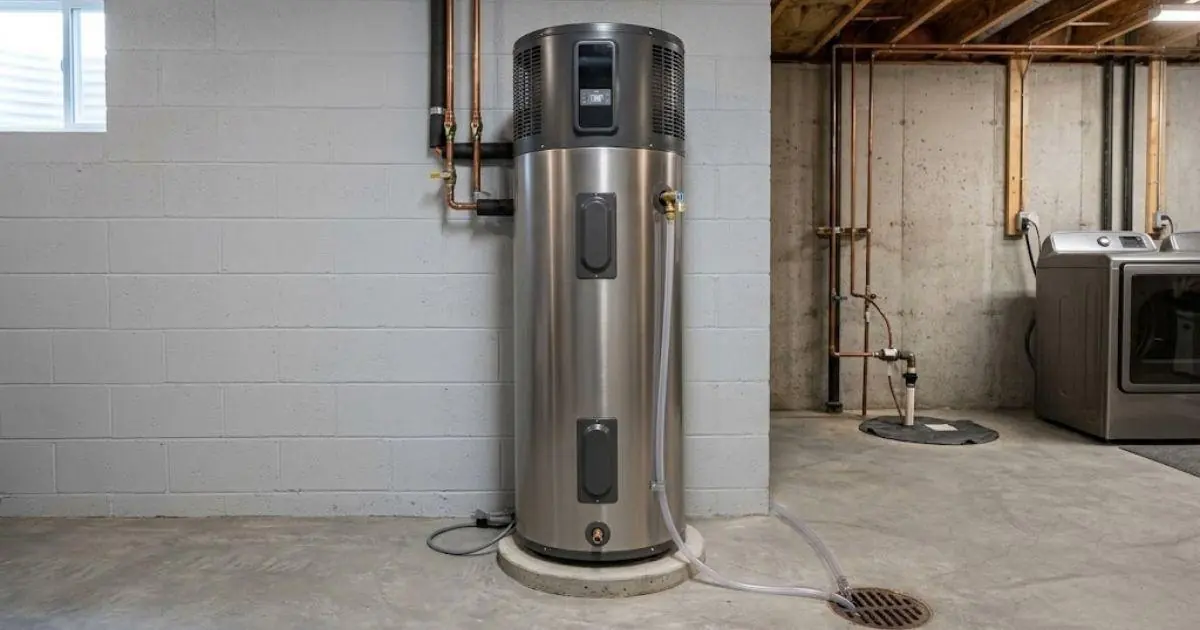
What a heat pump water heater actually is
A heat pump water heater looks like a tall tank, but it has a compressor and fan on top. Instead of heating water only with electric elements, it pulls heat from the surrounding air and moves it into the tank. Because it moves heat rather than creating all of it, it can use less electricity than a standard electric tank. Most models also carry backup elements for times of heavy demand.
The model is a good fit in a warm climate like ours, since the air around the unit is usually mild. It is not a fit for every house, though, and the installation has requirements a plain tank does not. This guide explains them so you can decide before you call.
What the room and the house must provide
A heat pump unit cools and dries the air it draws from, so it needs open space around it. Manufacturers list a minimum room volume and clearances in the installation manual, and a closet with a louvered door often works while a tight sealed cabinet does not.
- Space for the taller body and clear room above for service.
- A drain route for condensate, either by gravity or with a small pump.
- A dedicated electrical circuit of the size the nameplate calls for.
- Access for the old tank to leave and the new unit to arrive.
- Cold and hot water connections with working shutoffs.
If your current heater is gas, switching means running a new circuit. That can change the price of the job a great deal, so we look at the panel first.
Heat pump or standard electric tank
| Question | Heat pump unit | Standard electric tank |
|---|---|---|
| How it heats | Moves heat from room air, with backup elements | Electric elements only. |
| Electricity use | Often lower over a year | Higher for the same hot water. |
| Price to buy | Higher up front | Lower. |
| Space needed | More room and air | Compact. |
| Drain needed | Yes, for condensate | Only for the relief valve. |
| Noise | A fan and compressor hum | Quiet. |
The lower running cost can pay back the higher price, but how fast depends on your usage and on any rebates. Ask your electric utility and check current programs before you buy.
Talk to a plumber about heat pump water heater installation
Call the 24/7 line and describe your situation. We will say what we would check first.
How an installation day goes
We start by shutting off the water and power, draining the old tank and disconnecting it. The new unit is set level on a pan with a drain, connected to supply and hot lines with new flexible connectors or copper, and fitted with a temperature and pressure relief valve piped to a safe termination.
Then we run the condensate line, make the electrical connection and fill the tank before power goes on. Filling first matters because an element switched on in an empty tank burns out in seconds. We set the mode and temperature and show you the controls. For the scope of a standard job, see water heater installation.
Mistakes we see on these installs
- Placing the unit in a sealed closet so it starves for air and trips on low airflow.
- Running the condensate line uphill or leaving it uncapped so it drips on the slab.
- Skipping a drain pan under a unit above a finished space.
- Choosing the heat pump without checking the electrical panel has room for the circuit.
If you are replacing a failed tank in a hurry, the fast answer is often a standard tank today. A heat pump upgrade is best planned. See water heater replacement for the emergency path.
Questions to settle before you buy
Ask what the unit does in its efficiency mode and its backup mode, and how long it takes to recover after a heavy use day. Ask how loud it is at the fan, because a closet next to a bedroom is a different decision from a garage.
Also ask what the warranty covers on the compressor versus the tank, and whether the maker requires a particular installation detail to keep it valid.
Maintenance for a heat pump unit
Clean or replace the air filter if the model has one, keep the area around the unit clear and check the condensate drain for clogs. Flush the tank on the maker's schedule to clear sediment.
These tasks are small and keep the unit running as designed.
A local note for North Miami Beach homes
NMB Water's 2025 report says the city supply is blended and disinfected, and brown or yellow water can come from rust inside aging or galvanized pipe. Sediment in the supply shortens the life of any tank, so ask us to flush and inspect the connections when we install. The city also advises flushing a heater at least twice a year.
Permits for water heater work differ by municipality and by house type. Ask the building department that covers your address what applies before work begins. Our two nearest service areas are North Miami and Aventura.
Questions about this topic
It can, since the air is warm much of the year. The unit still needs the clearance and airflow in its manual, and a drain for condensate.
Yes, somewhat. It pulls heat from the air around it and releases cooler, drier air, which some owners welcome in a utility space.
Only if the closet meets the airflow and volume the manufacturer lists. A louvered door often helps.
Often a standard tank gets hot water back faster, and the upgrade can be planned afterward.
Not the type, but sediment affects every tank, so plan on regular flushing.
Want a plumber to look at it?
Call the line and describe what you see. We will say what we would check first.